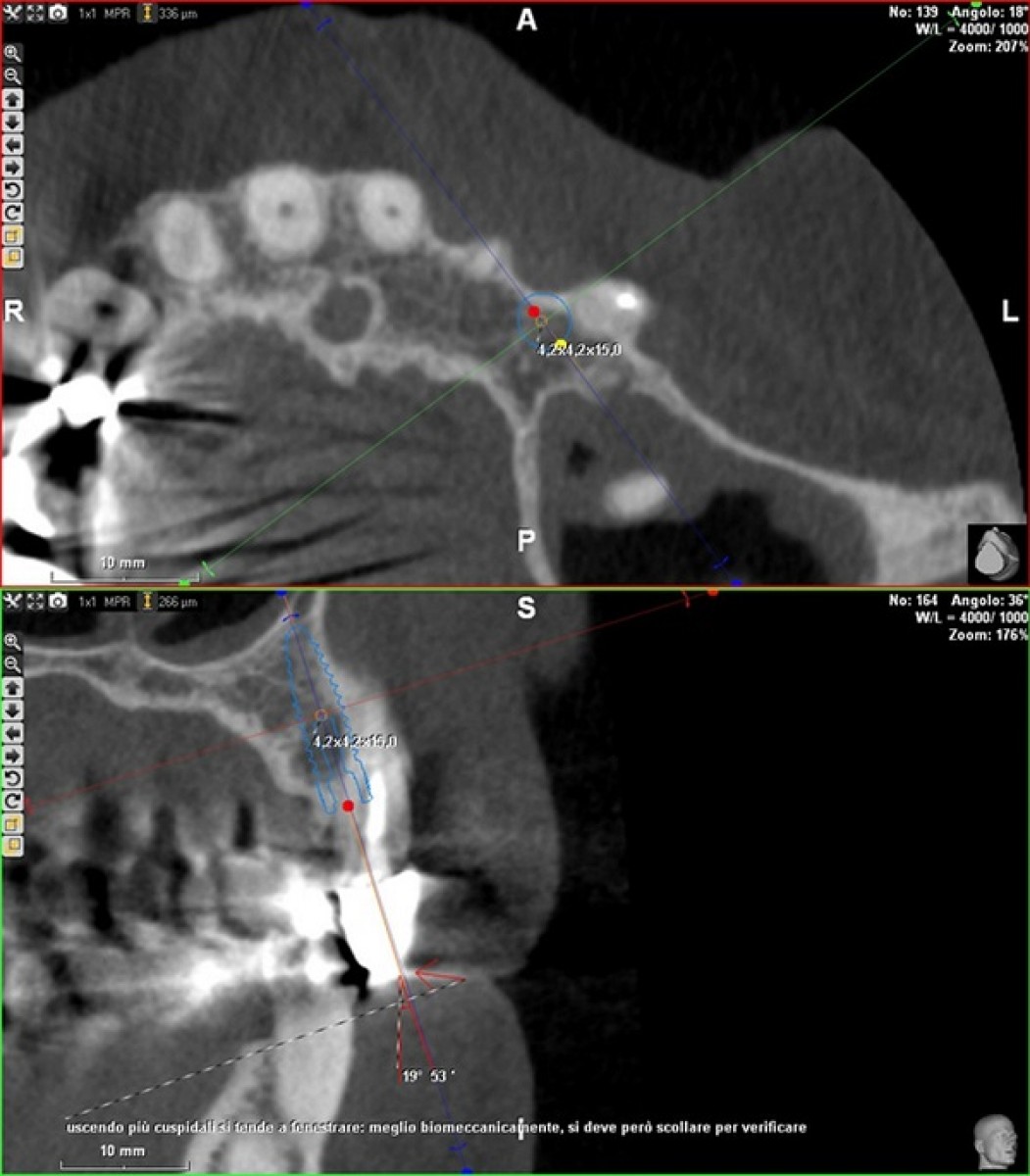

As part of implant prosthetic rehabilitation in the esthetic zone, adequate hard and soft tissue reconstruction is essential. Such reconstruction is achieved through guided bone regeneration (GBR), which involves the placement of a membrane between the soft tissues and the osteoconductive graft, which in turn rests on the recipient bone site. This study presents the results of a mid-term retrospective analysis of the use of an equine-derived cortical bone membrane in implant placement surgery and concomitant guided bone regeneration.
Medical records of patients who had at least one implant placed concurrently with guided bone regeneration surgery were selected. Implant success was assessed through the criteria of Albrektsson and Zarb. Where available, any histologic and tomographic (CBCT) data were also qualitatively analyzed.
The results refer to 17 patients aged 36 to 67 years, mean 53.7 ± 9.2 years, who had 24 implants placed. The mean follow-up was 38.1±3.7 months. Two implants failed, resulting in an implant success rate of 87.5%. Seven membrane specimens were histologically analyzed at a mean time from surgery of 4.3±1.2 months: all portions considered were still occlusive. Six CBCT scans all showed, at the graft area, the formation of a cortical bone layer.
Equine cortical membranes appear to possess a long permanence and medium-term barrier and remodeling effect allowing the formation of a cortical tissue layer not dissimilar to that physiologically present in the alveolar process.
Vicenza
Headquarter
via E. Fermi, 49
36057 Arcugnano, Vicenza (VI) - Italy
Tel. +39 0444 289366
Fax: +39 0444 285272
Torino
Multi-function production center
Via G. Agnelli, 3
10020 Riva presso Chieri, Torino (TO) - Italy
Copyright © 2026 Bioteck S.p.A. - Privacy Policy - Cookie Policy

In compliance with the law, I declare under my responsibility that I am a professional in the sector and that I am therefore authorized to view the content on this website.
Close this popup to continue, or click here to be redirected.